Turn production alerts
into evidence-backed diagnoses
BitSentry monitors production signals 24/7, investigates incidents with AI, and uses human-defined runbooks as the trust layer between agents and your systems.
Limited cohort · 1 to 3 teams
Agents are already in production
Governance isn't
85% of surveyed organizations already run AI agents in production (CSA, 2026), and 65% reported at least one agent-related incident in the past year (CSA, 2026). This is what agent access without a control layer looks like.
-
01 Untracked agents
82%≈ 9 in 11 teams found agents nobody had tracked
82% of surveyed teams discovered previously unknown agents in their environments.
Cloud Security Alliance (2026) -
02 Excess access
74%Access the task requiresAccess the agent holds74% report agents with more access than their tasks require.
Cloud Security Alliance (2026) -
03 Attribution gap
68%
can't tell agent from human
68% cannot clearly separate agent activity from human activity in their systems.
Cloud Security Alliance (2026) -
04 Hard to monitor
79%
access pathways hard to monitor
79% describe the pathways agents use to reach systems as hard to monitor.
Cloud Security Alliance (2026)
Read the zero trust operating model →
Self-reported survey data, not BitSentry measurements.
Trust your agents
in production
BitSentry Cloud does not replace your monitoring. Human-defined runbooks act as the trust layer, guiding each investigation and recording every command, response, and result. It is independent of BitSentry Desktop, so no desktop app is required.
Tribal knowledge codified
One source of truth for how your team diagnoses production. New hires inherit tribal knowledge on day one.
Always-on investigation
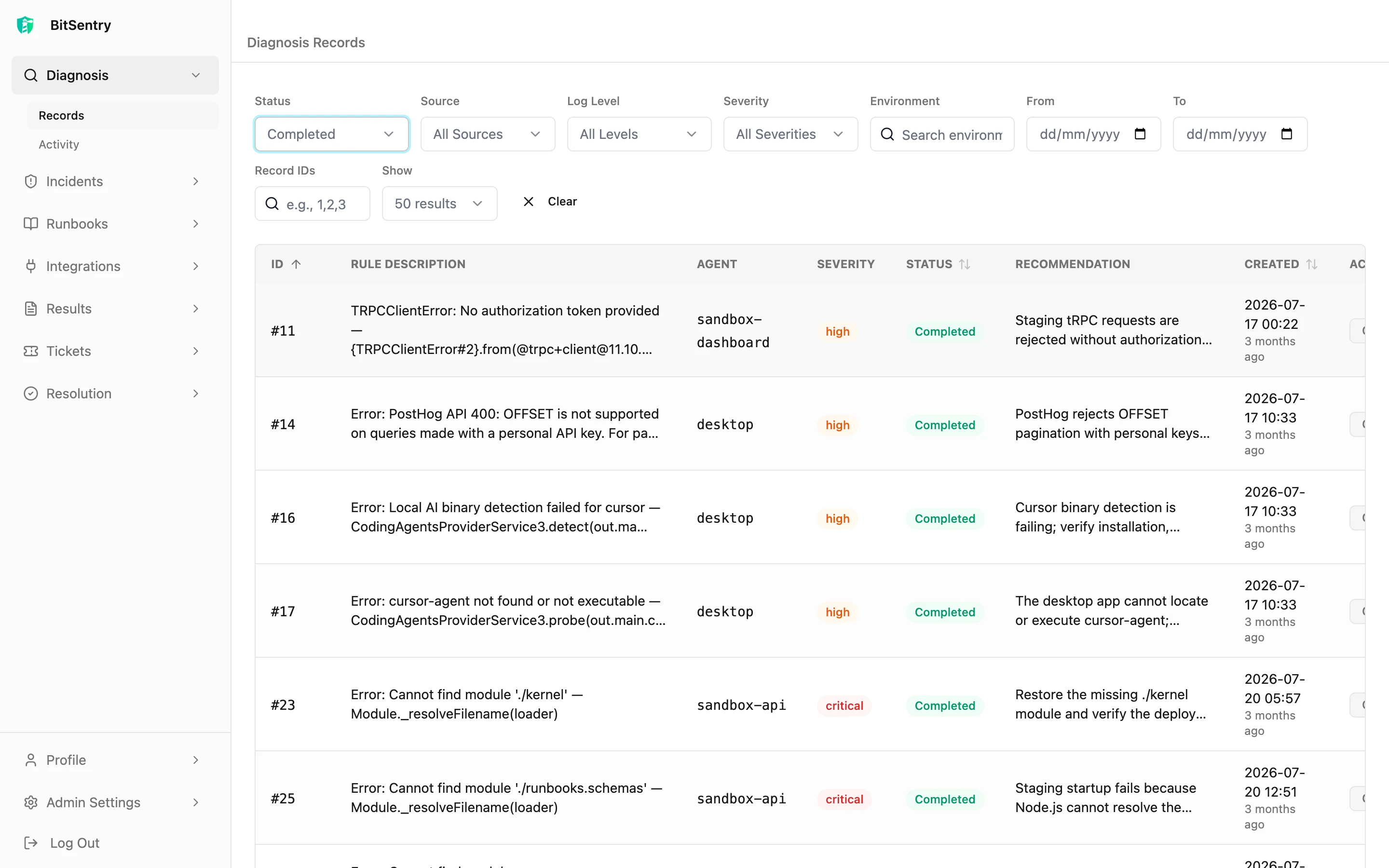
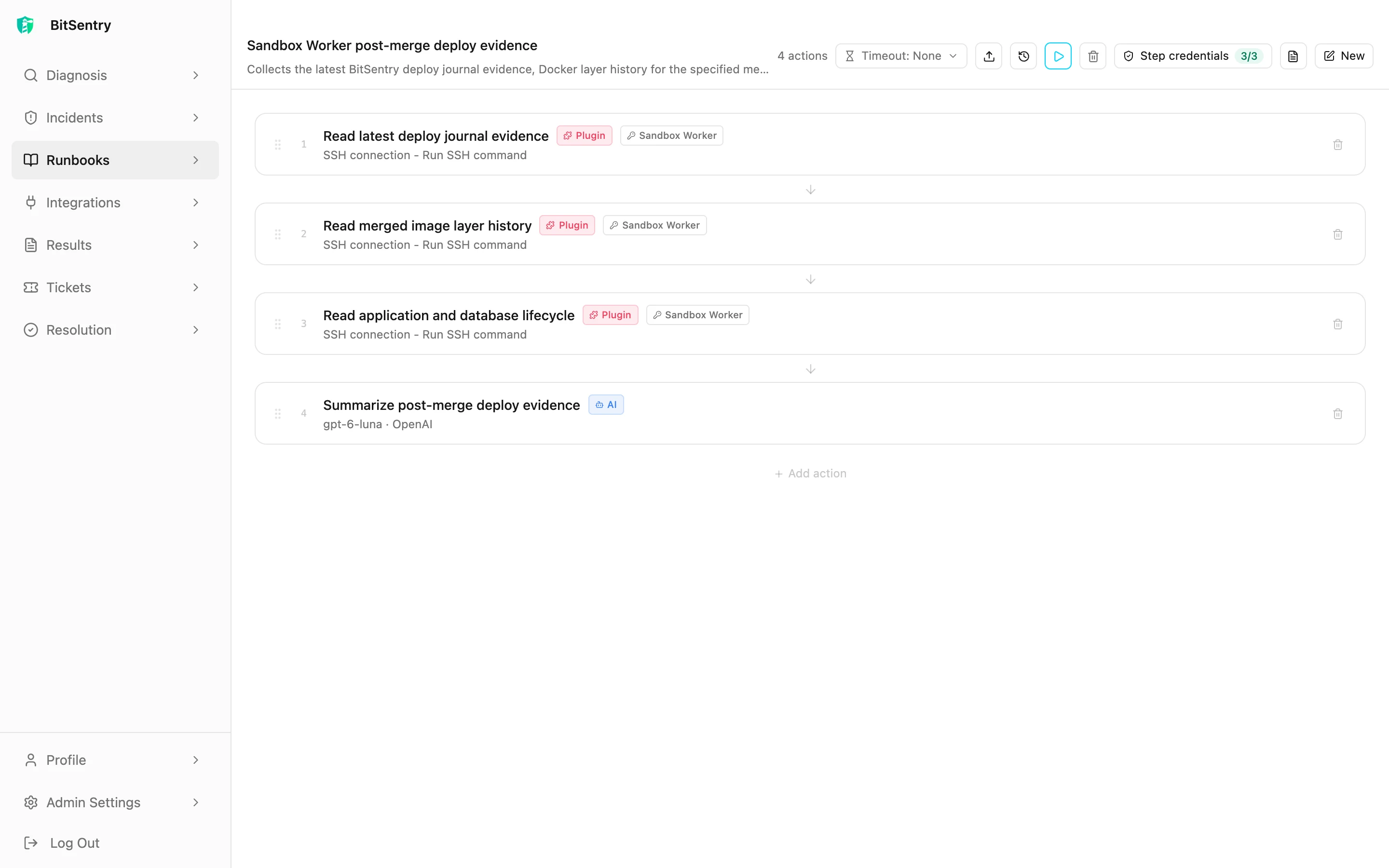
New alerts start a background AI diagnosis across your connected sources, so the findings and evidence are ready before anyone opens their laptop.
Trust but verify
Runbooks define the boundaries agents operate in. Every command, response, and output is captured as evidence for compliance.
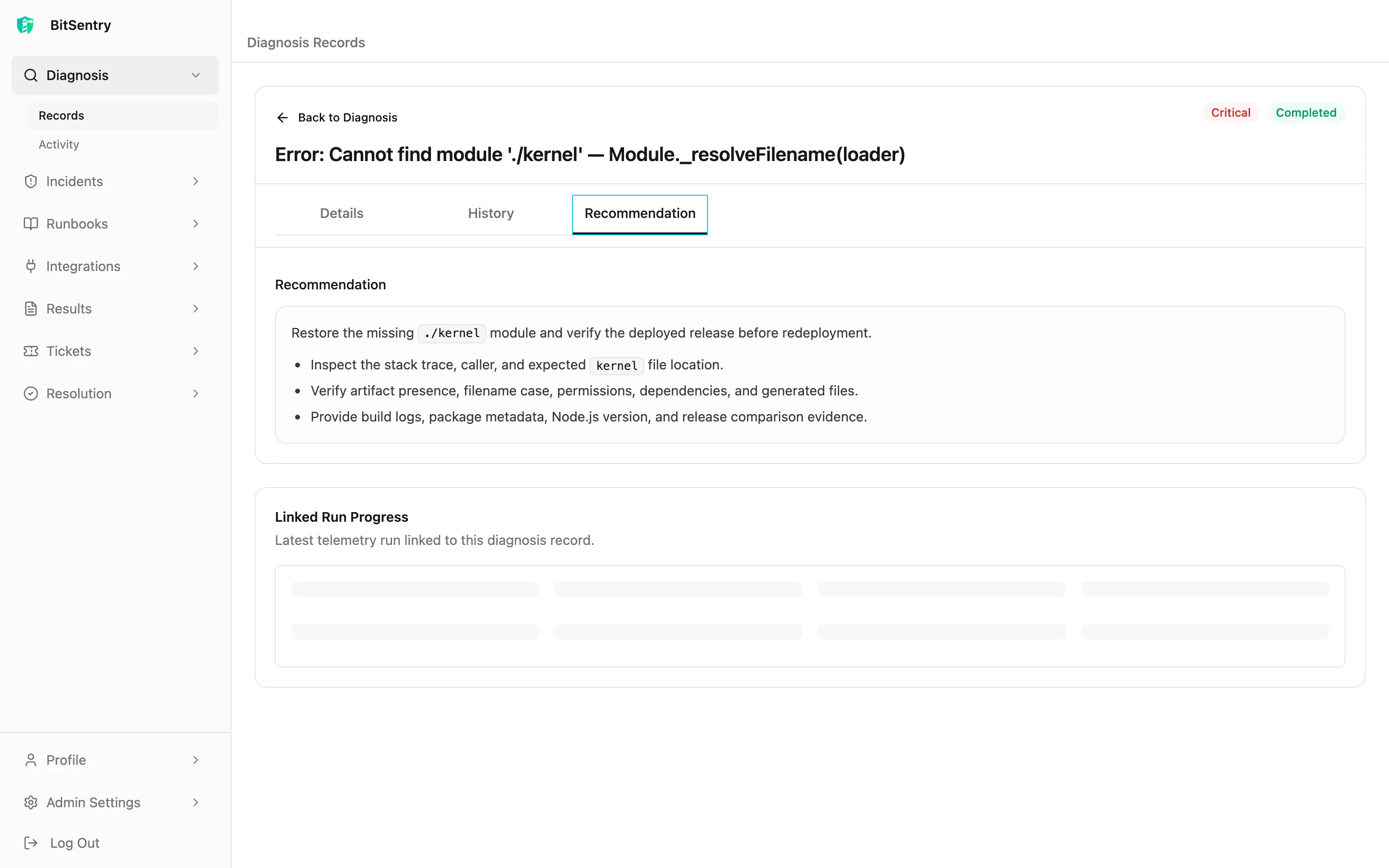
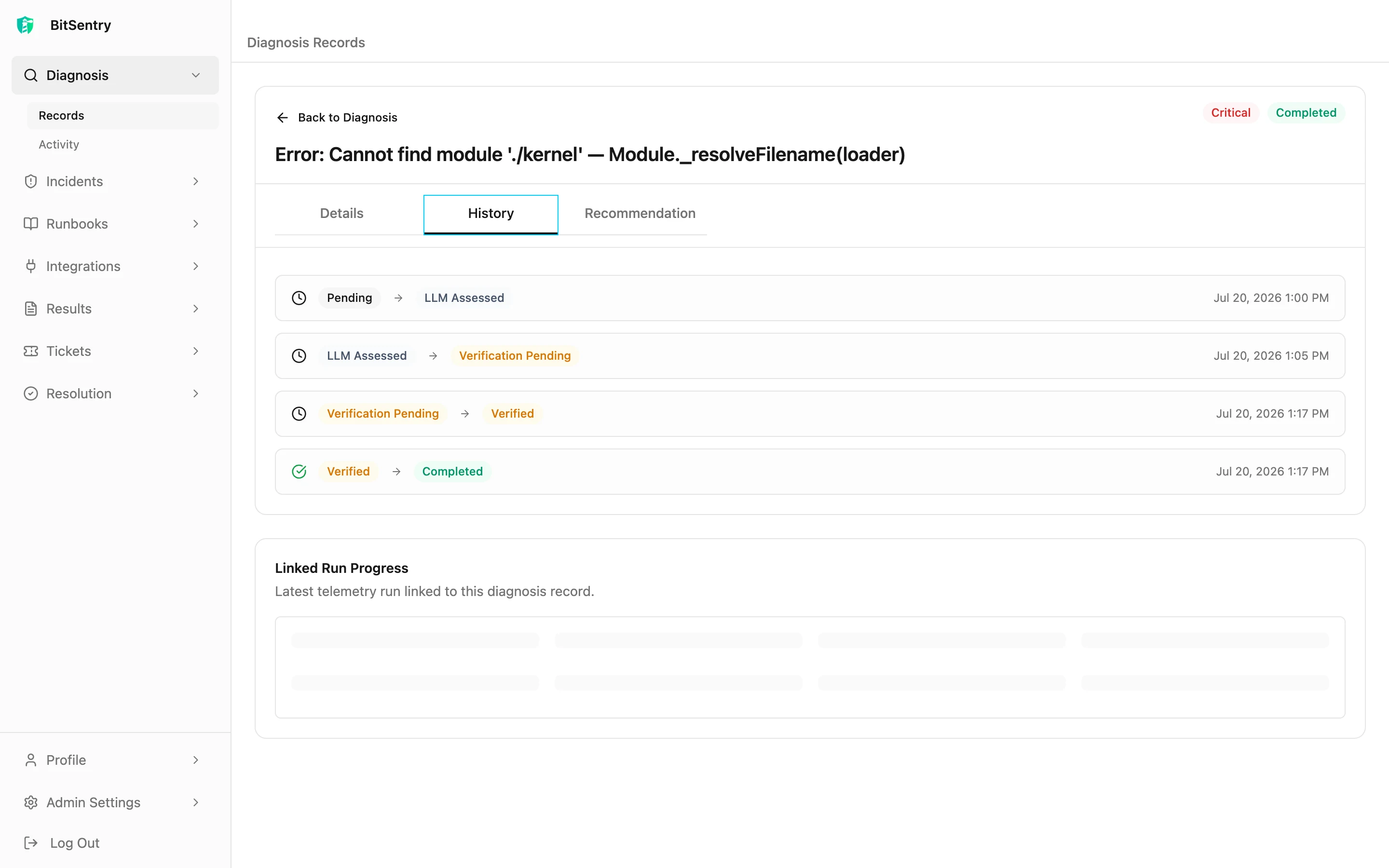
From alert to diagnosis
while your team is asleep
Don't take our word for it
See what the industry measured
Four numbers from peer-reviewed AIOps and failure-diagnosis studies, in the order an incident unfolds: detect, diagnose, recover, and stop the repeat.
-
01 Time to detect
−84%Before 51 minAfter 8 minMean time to detect an incident across a 2,500-container Kubernetes estate.
Amgothu et al., FRUCT 38 (2025) -
02 Time to diagnose
−99%~75×
faster to root cause
112 min → ~1.5 min
Runbook-guided diagnosis vs on-call engineers across 67 production failures at Alibaba.
Zhao et al., ICSE-SEIP 2026 -
03 Time to recover
−78%79 min17 minMean time to recover from an incident in the same enterprise deployment.
Amgothu et al., FRUCT 38 (2025) -
04 Recurring incidents
−23%≈ 3 in every 13 repeat incidents prevented
Incident recurrence after automated remediation policies were added.
Amgothu et al., FRUCT 38 (2025)
Also reported in Amgothu et al., FRUCT 38 (2025): actionable alert volume −43% (SaaS case), false positives halved (18% → 9%) and downtime −62% (fintech case).
Industry benchmarks, not BitSentry results.
What changes on day one
The same on-call work, before and after the runbook layer.
Before BitSentry Cloud
Manual investigation
Log into a server manually
Grep logs from memory
Tribal knowledge in one engineer's head
Slack thread full of guesses
No consistent audit trail
After BitSentry Cloud
Shared runbooks
Run a reviewed diagnostic runbook
Repeatable, shared checks
AI explains the output to anyone
Evidence-backed diagnosis
Every step logged and reviewable
BitSentry Cloud may
not be for you if
We'd rather lose a fit call early than over-promise. If any of the below sounds like you, we're probably not the right tool today.
You only need hands-on investigations from your own computer. Start with BitSentry Desktop instead of an always-on team service.
You have a strict no-AI policy for operational data, even for read-only summarization.
You want a fully autonomous agent that fixes production on its own. BitSentry produces the diagnosis and the evidence. The operator decides what action to take.
How the team
collaborates
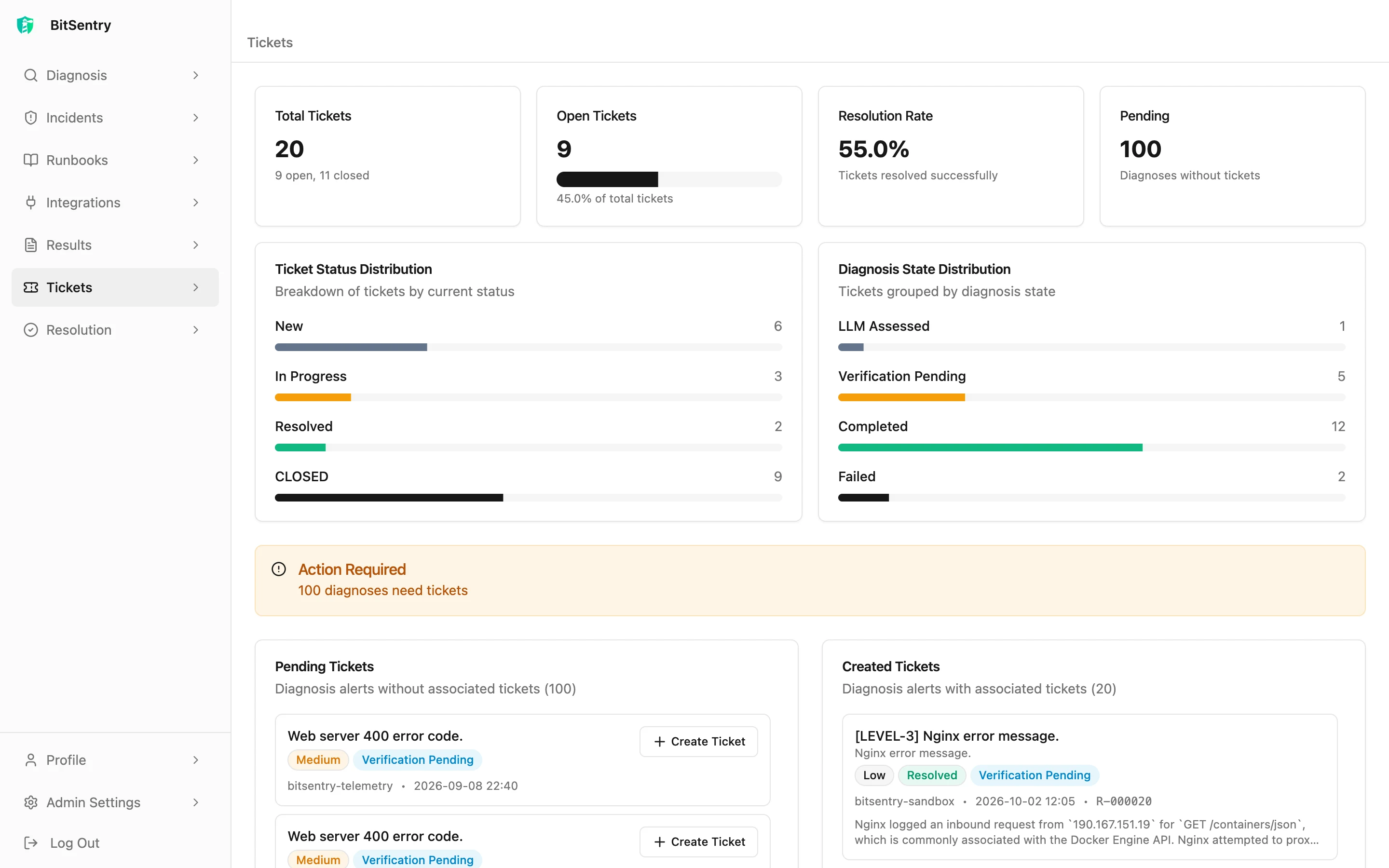
The diagnosis is only half the job. BitSentry Cloud gives the whole team one place to see, hand off, and learn from every investigation.
Shared diagnosis queue
Open diagnoses sit in one queue with their state, so everyone sees what is being investigated and what is waiting on review.
Investigation history and handoff
Every run is kept with its evidence in the incident thread. Hand it to the next on-call mid-incident with nothing lost.
Versioned runbook library
The team's diagnostic checks live in one library with revisions, so an improvement by one engineer reaches everyone.
Plugs into what you already run
Every integration is a code plugin. BitSentry Cloud pulls from your monitoring and security tools 24/7.
 SigNoz
Book a demo
Start with one runbook
Bring us one recurring incident type. We will help turn it into a reusable diagnostic runbook and measure time-to-root-cause before versus after. 1 to 3 teams this quarter.
Pick one incident type
Disk full. API 500s. Queue backlog. The one your on-call keeps seeing.
We build the runbook with you
Real commands against your stack. AI interpretation. You review the evidence before acting.
Measure before vs after
We track time-to-root-cause across the next 3 incidents. You decide if it's worth keeping.
30-minute intro call. Bring one recurring incident and a sample alert, and we will walk through it with you.