See it in action
Watch a runbook walk through an incident.
Two minutes. One real-shape diagnostic runbook, run from SuperTerminal against a sample stack. Local-first, AI-interpreted, evidence captured.
Free while in beta. macOS, Linux, Windows.
Runbooks that read the output.
Get a diagnosis,
not just logs.
Run SSH runbooks. The AI reads each step's output and tells you what it means.
Describe the Problem, Get the Cause
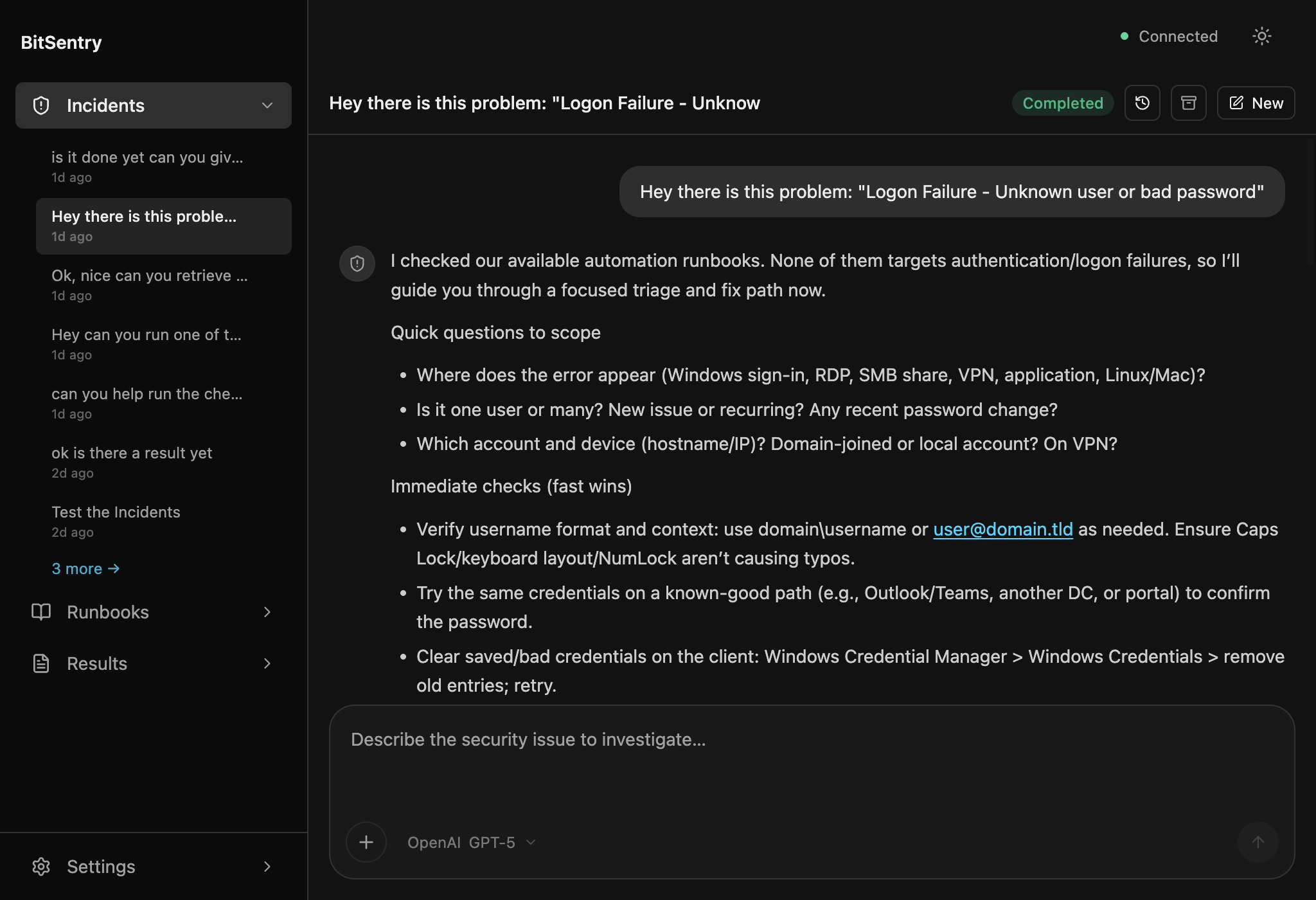
Type what's wrong in plain English. SuperTerminal SSHes in, pulls logs, and tells you what broke.
Runbooks That Pass Data Between Steps
Chain shell commands, HTTP calls, and AI steps. Reference any step's output in the next one. The AI reads results and explains what each step means.
Runs on Your Machine
SSH execution runs locally. AI calls go directly to the provider you choose.
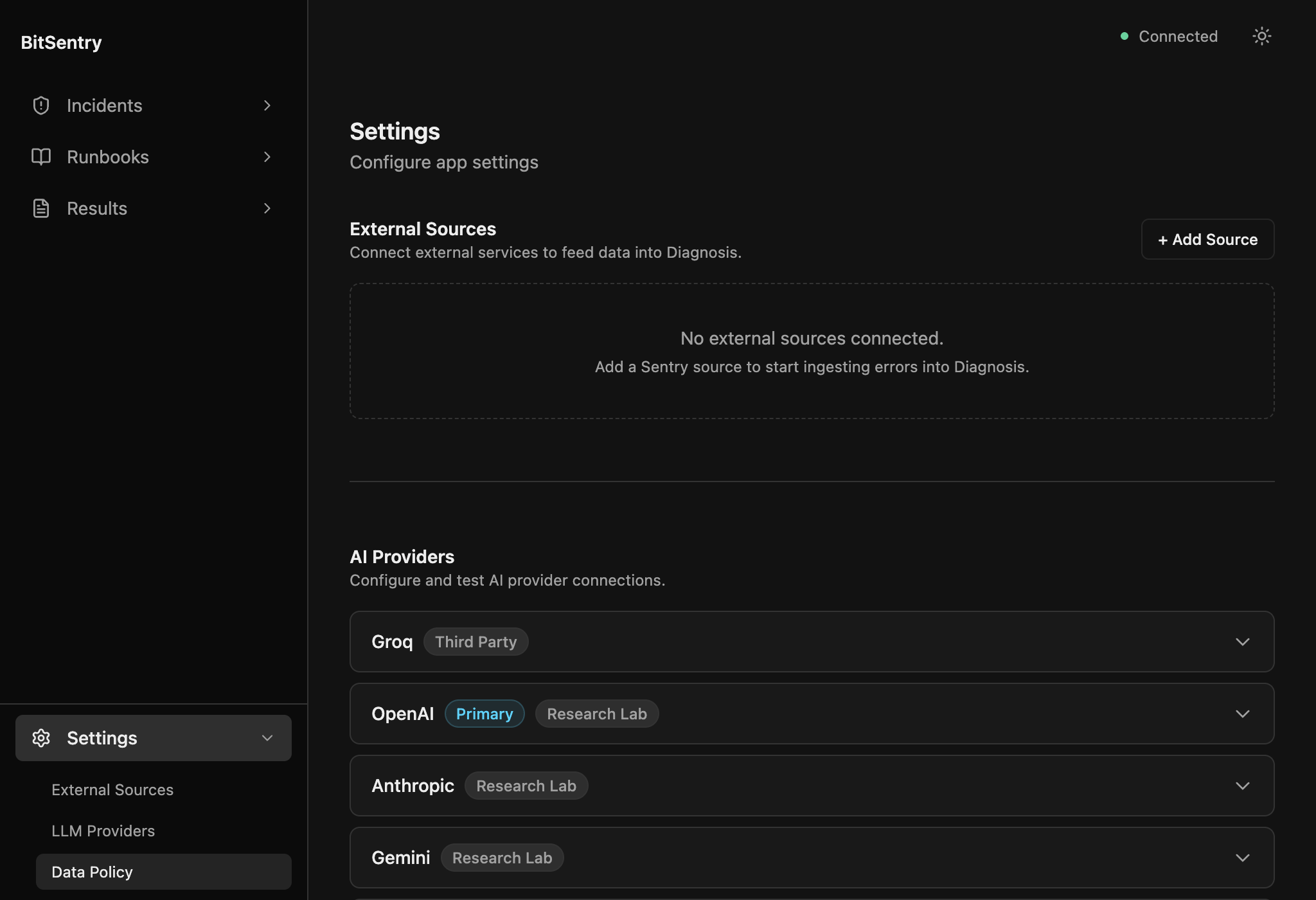
Bring your own AI model
Bring your own AI provider
No middleman
Your API keys go straight to the provider you pick. Logs never touch BitSentry servers.
From incident to resolution
Build a runbook, describe the incident, get an answer
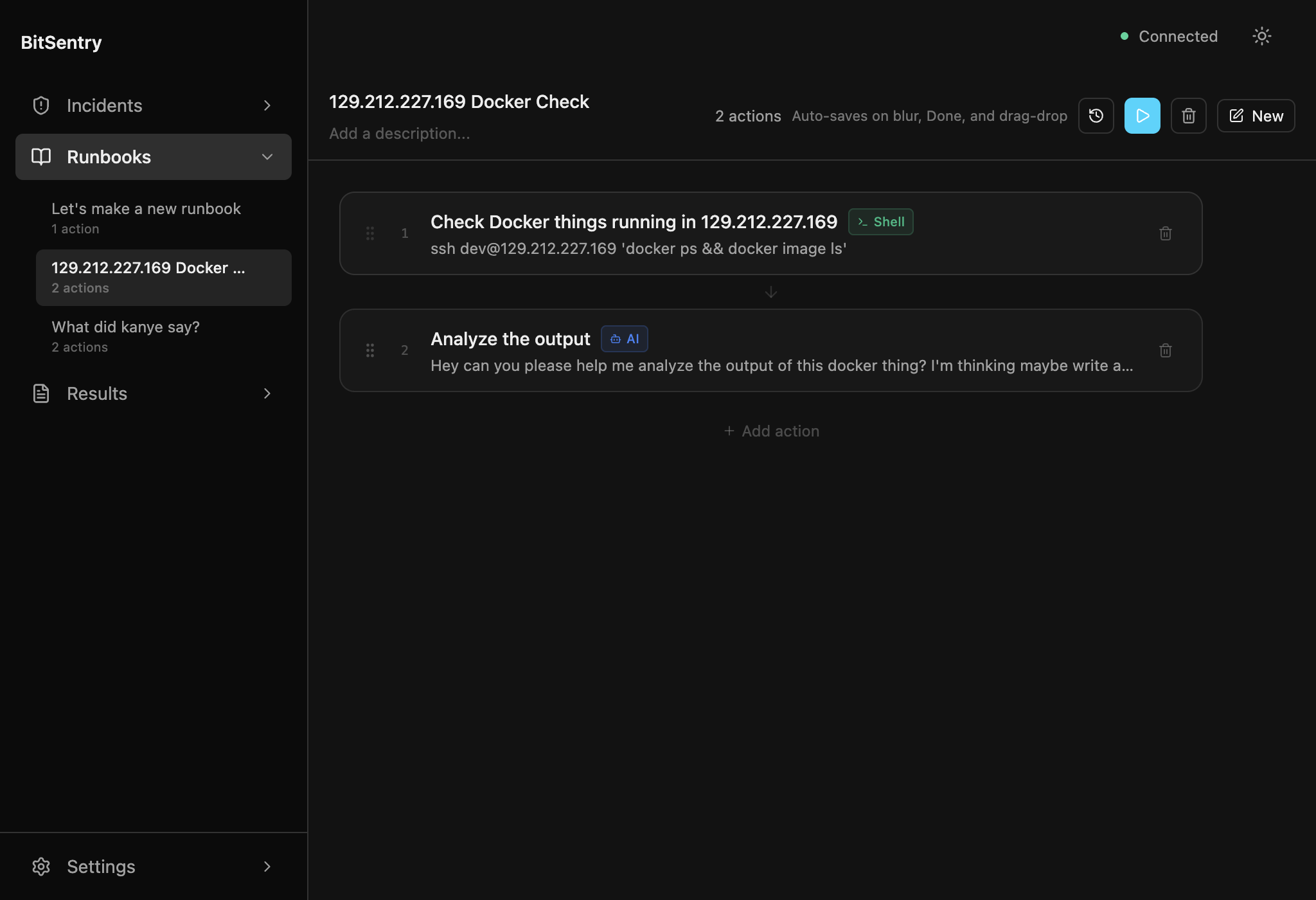
Build a Runbook
Chain commands, HTTP calls, and AI steps into a runbook. Drag to reorder, run on any server.
Investigate with AI
Type what's wrong. SuperTerminal SSHes in and tells you what caused it.
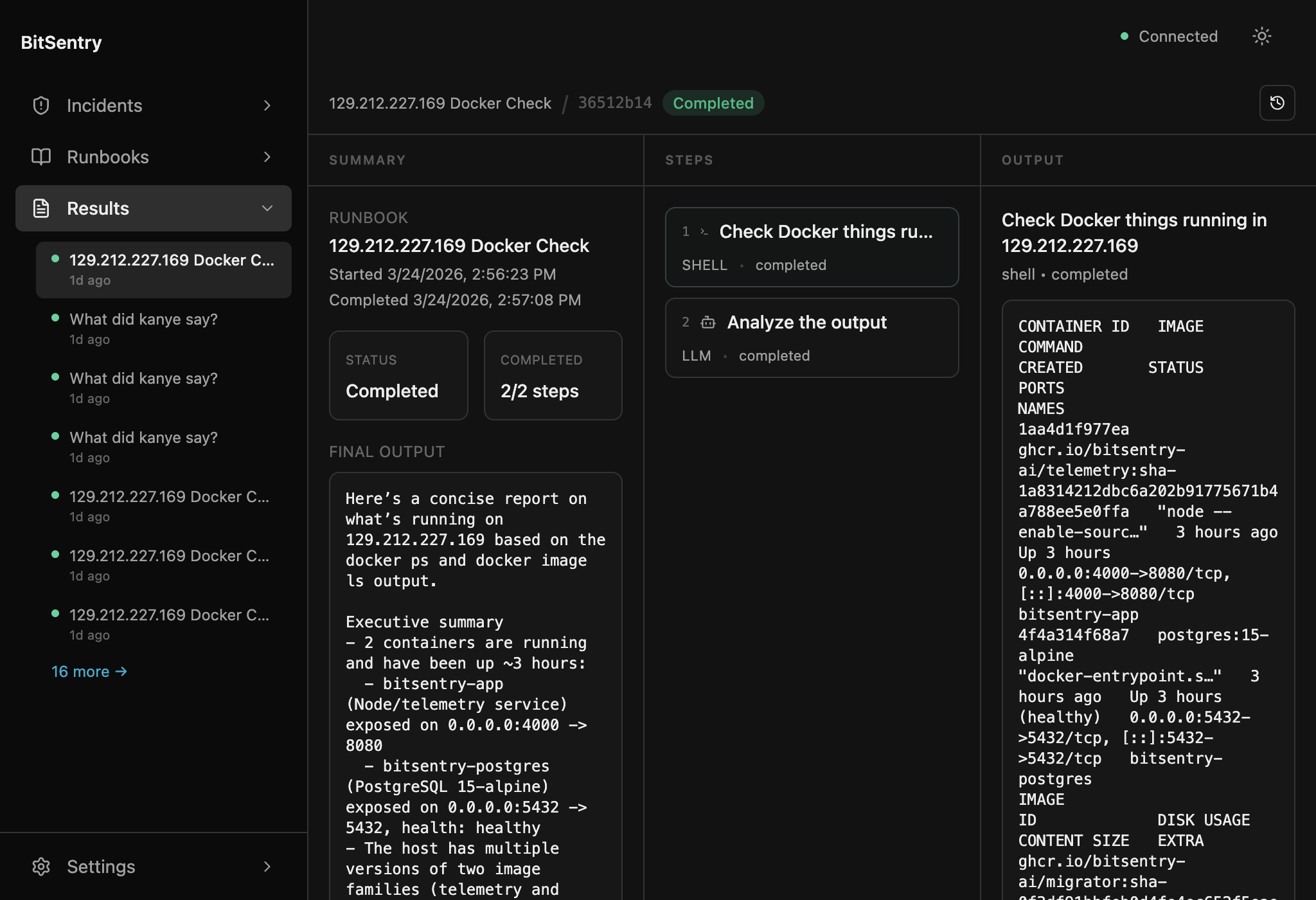
Execute and Review
Run it against your servers. Every step logged so you can review exactly what happened.
Honest objection
Why not just use Claude Code?
You can SSH into a box, pipe logs into Claude, and ask what's wrong. It works. If you're diagnosing the same kind of incident more than once a month, a purpose-built tool starts paying off. The differentiator isn't raw AI intelligence. It's operational repeatability.
Claude Code / Codex
-
Ad-hoc conversation
Every incident starts from scratch.
-
Context lost after chat
The next on-call rebuilds the same investigation.
-
Hard to share as process
Tribal knowledge stays with whoever typed the prompt.
-
Weak audit trail
Hard to reconstruct what ran and what AI said for compliance.
SuperTerminal
-
Repeatable diagnostic runbook
Build the investigation once. Run it the same way every time.
-
Investigation history retained
Every run, every output, every AI reading is captured.
-
Shared runbook library
Junior on-calls inherit senior engineers' muscle memory.
-
Evidence trail
Command, output, and AI response linked for the post-mortem.
For one-off debugging, Claude Code is hard to beat. SuperTerminal wins when the same incident type keeps showing up and you need the whole team to handle it the same way.
Works With Your Stack
Fetch errors and metrics from your tools. Push results to your ticketing system. All read-only, on-demand.
 SigNoz
 OpenCode
 Cursor
Your Machine, Your Provider
SuperTerminal is a desktop app, not a SaaS. SSH execution runs locally, and AI analysis goes directly to your configured provider.
System SSH Only
SuperTerminal uses your existing SSH identity. No SSH keys stored by BitSentry. Your credentials stay on your machine.
Every Action Logged
Full execution log for every runbook run. Shell output, AI responses, and HTTP calls are all saved locally for review and compliance.
Runs on Your Machine
No proxy. SSH goes to your servers. AI calls go to your provider. BitSentry never sees your logs.
Get SuperTerminal.
Free during public beta. Bring your own AI provider. SSH stays on your machine.
macOS · Apple Silicon & Intel